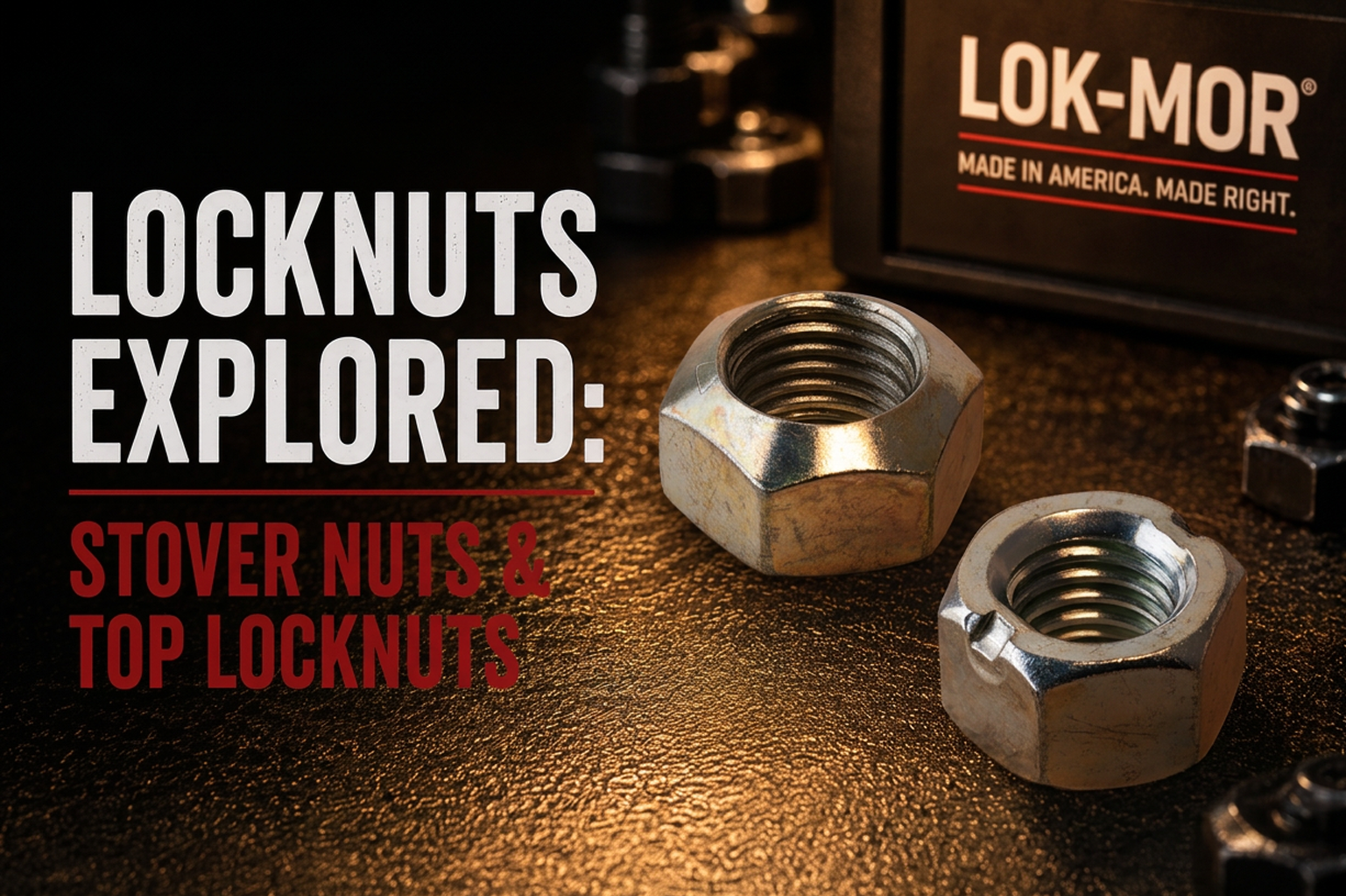
Customers in the automotive, agricultural, heavy equipment, and other industrial markets often ask how all-metal locknuts handle vibration, heat, and repeated loading. Two terms that come up frequently are stover nuts and top locknuts.
In common fastener usage, a stover nut is a type of all-metal top-locking prevailing-torque nut. Supplier terminology can vary, so procurement teams and engineers should confirm the actual requirements rather than rely on the name alone. This guide explains how these designs work, how they compare, and several related Lok-Mor options. For a broader introduction, see our guide to prevailing-torque locknuts.
How Stover Nuts and Top Locknuts Work
Stover nuts and other top locknuts belong to the prevailing-torque category. Instead of spinning freely all the way to the bearing surface, they begin to resist turning when the bolt reaches the locking section of the nut. From that point, installation requires wrenching torque.
The locking feature is created by intentionally deflecting or distorting part of the nut’s internal thread. As the bolt passes through that area, the mating threads press against one another, creating friction and distorting the threads of the nut. These designs help resist vibration or changes in clamp load, which would otherwise allow a standard nut to loosen more easily.
For more background on the forces that cause threaded joints to loosen, read Why Do Locknuts Loosen? Understanding the Science of Joint Integrity. For practical installation guidance across different locking styles, see How to Install a Locknut: A Straightforward Guide.
Stover Nuts vs. Top Locknuts: What Is the Difference?
The terms overlap, and different suppliers may use them somewhat differently. The most useful distinction is that “top locknut” describes a broader family of prevailing-torque nuts with a locking feature near the top, while “stover nut” commonly refers to a top-locking all-metal design with a tapered or domed upper profile.
- Stover nut: Typically has a tapered or conical upper section with the locking feature formed near the top of the nut. Exact dimensions and thread distortion can vary by design.
- Top locknut: A broader description for locknuts that create prevailing torque near the top of the nut. The upper profile may be tapered, flat, oval, or domed, depending on the design.
- Locking geometry: Different top-lock designs may use two, three, oval, or other locking elements. These variations affect how the nut engages the bolt and can influence installation torque and application fit.
- Automated assembly: Some tapered or domed designs are easier to orient in automated feeding and assembly equipment. Lok-Mor’s DOME-LOC®, for example, is designed with automated assembly in mind.
For purchasing, the safest approach is to specify the thread, material, finish, locking requirement, dimensional standard or drawing, and any torque requirements. Our locknut RFQ guide for distributors and procurement professionals provides a useful checklist for requesting an accurate quote.
When All-Metal Top Locknuts Make Sense
Because stover and most top locknuts are all-metal designs, they can be a strong choice when a polymer locking element is not appropriate. Common considerations include:
- High temperatures: All-metal locking features are often considered when service temperatures exceed the limits of nylon inserts. The actual temperature capability depends on the nut material, strength grade, finish, mating fastener, and governing specification.
- Vibration and shock: The built-in thread interference creates resistance to rotation, making prevailing-torque top locknuts useful in many automotive, agricultural, machinery, and other dynamic applications.
- Chemical exposure: An all-metal locking feature avoids relying on a polymer insert that may be affected by certain chemicals. Material and coating compatibility still need to be checked for the specific environment.
All-metal is not automatically the best choice for every assembly. Nylon-insert designs can offer advantages in other environments and applications. For a direct comparison, read Choosing the Right Locknut: All-Metal Versus Nylon Locknuts.
Reusability should also be evaluated separately from material. Prevailing-torque performance can change after installation and removal, depending on the design and specification. If a joint will be serviced repeatedly, review Are Locknuts Reusable? A Manufacturer’s Insight before specifying the fastener.
Examples of Top-Locking Nuts from Lok-Mor
Lok-Mor manufactures several all-metal prevailing-torque designs that use locking elements at or near the top of the nut. Examples include:
- TRI-LOC®: Three locking elements at the top deflect the nut’s threads to create prevailing torque and resist loosening under vibration.
- ST-LOC™: This side-top design uses positive thread deflection on two sides at the top of the nut.
- O-LOC™: Two oval-shaped locking elements at the top create frictional interference with the mating bolt threads.
- DOME-LOC®: This dome-style prevailing-torque locknut is a stover-style option designed to support automated assembly.
These are only a few examples within Lok-Mor’s broader prevailing-torque locknut line. The right choice depends on the required torque, thread size, material, finish, temperature, vibration level, installation method, and applicable specification.
Made in America. Made Right.™
Lok-Mor manufactures and locks its locknuts at our headquarters in Mansfield, Texas. Our quality program is supported by an A2LA-accredited laboratory and is established to meet customer and industry requirements including ISO 9001:2015, ISO/IEC 17025, ANSI/ASME, ASTM, and other applicable specifications.
Procurement teams that need help with documentation and standards can also review our Guide to Locknut Standards and Certifications.
Unsure Which Top Locknut Is Right for Your Application?
- Call 800-843-7230 or email us at [email protected]
- Submit a Contact Form or Get a Quote
- Browse our complete Made-in-America™ collection of locknuts