Locknuts are often the smallest components in a massive assembly, yet they carry some of the heaviest responsibilities. A single loose nut on a wind turbine, a railcar, or an oil rig can lead to catastrophic failure, costly downtime, and severe safety hazards.
At Lok-Mor, we believe that understanding why locknuts fail is the first step toward ensuring long-term reliability and assembly-integrity. That’s why our locknut experts have created this short guide explaining the forces behind locknut loosening – along with specialized locknuts that can withstand them.
The Stiff Spring Principle
To understand why a nut loosens, we must first understand how it stays tight. When a bolt is properly tightened, it stretches, creating a clamping force known as preload. This force generates static friction between the nut’s threads, which keeps the assembly secure. The locknut will remain tight as long as this friction remains.
Common Causes of Loosening
Several environmental factors work to overcome that friction:
- Vibration and Dynamic Loads: Repeated oscillations from engines or heavy machinery can be the leading cause of failure.
- Embedment and Relaxation: Shortly after installation, microscopic settling or “material seating” can occur at the contact surfaces, causing a slight loss of preload.
- Thermal Expansion: Fluctuating temperatures cause metals to expand and contract at different rates, leading to relative movement between parts.
- Improper Torque: If a nut isn’t tightened to the correct initial preload, it cannot generate enough clamping force to resist movement in the first place.
How Self-Loosening Happens
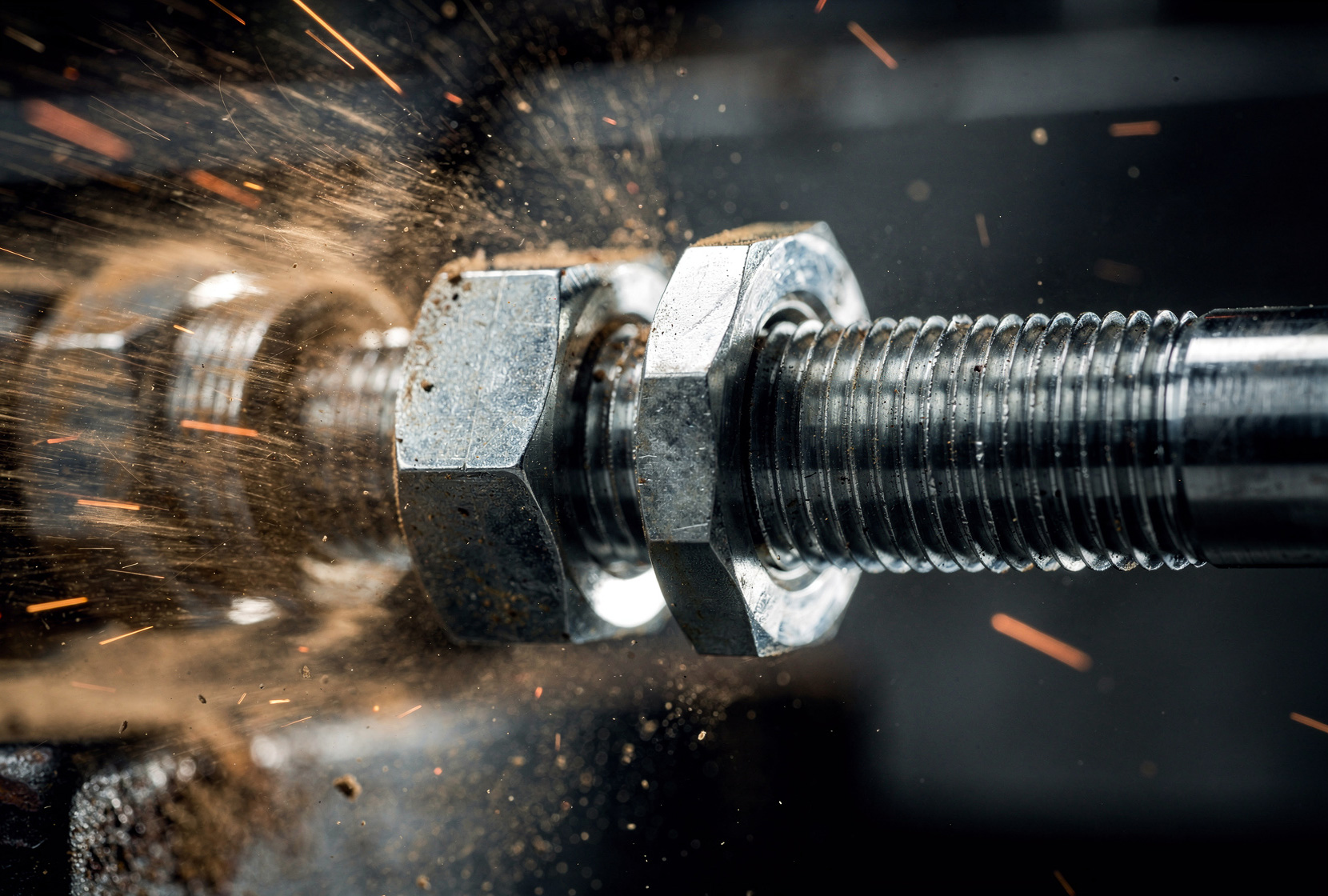
The most frequent cause of loosening is side-to-side sliding. When vibration becomes strong enough to overcome the friction holding the joint together, microscopic slipping occurs between the threads.
Once this friction is momentarily overcome, the internal tension acts like a released spring, naturally returning the nut to its original state. This causes the locknut to gradually rotate counterclockwise – a phenomenon known as rotational self-loosening.
Over repeated cycles, the nut backs off entirely, resulting in joint failure.
Combatting Vibration with Resistant Locknuts
Standard nuts and washers often fail in these high-stress environments. To combat this, Lok-Mor manufactures specialized locknuts that maintain joint integrity under intense vibration, known as prevailing-torque locknuts.
There are many different types of prevailing-torque locknuts. In general, they create constant frictional resistance by slightly deforming the nut’s threads or using a nylon insert to grip the bolt. This ensures the nut remains secure even if the clamping force is partially lost.
Some common examples from Lok-Mor include:
- The N-LOC™ – this is our nylon-insert locknut, also known as a nyloc. It features a nylon ring at the base, which deforms around the threads during installation to prevent loosening.
- The TRI-LOC® – This locknut is easily identifiable by the three locking elements at the top of the nut. These deflect the bolt threads during tightening for a permanent solution to loosening.
- The ANCO® PN-LOC® – Our signature locknut and the most vibration-resistant option. A stainless-steel ratchet pin slides over the threads and locks into place, preventing loosening, even under the most intense conditions. The exceptional performance of the ANCO® PN-LOC® earned it a spot on Fastener Technology International’s top products list in 2024.
For more information on prevailing-torque locknuts and how they work, read our blog on the subject: What are Prevailing-Torque Locknuts and How are They Used?
Made in America. Made Right.™
Since 1982, Lok-Mor has set the standard for domestic locknut quality. All of our 18+ locknut styles are manufactured and tested in our A2LA-accredited lab in Mansfield, Texas, to ensure they withstand the toughest conditions on earth.
Stop the cycle of loosening. Talk to a Lok-Mor expert today by emailing [email protected] or by filling out our contact form.