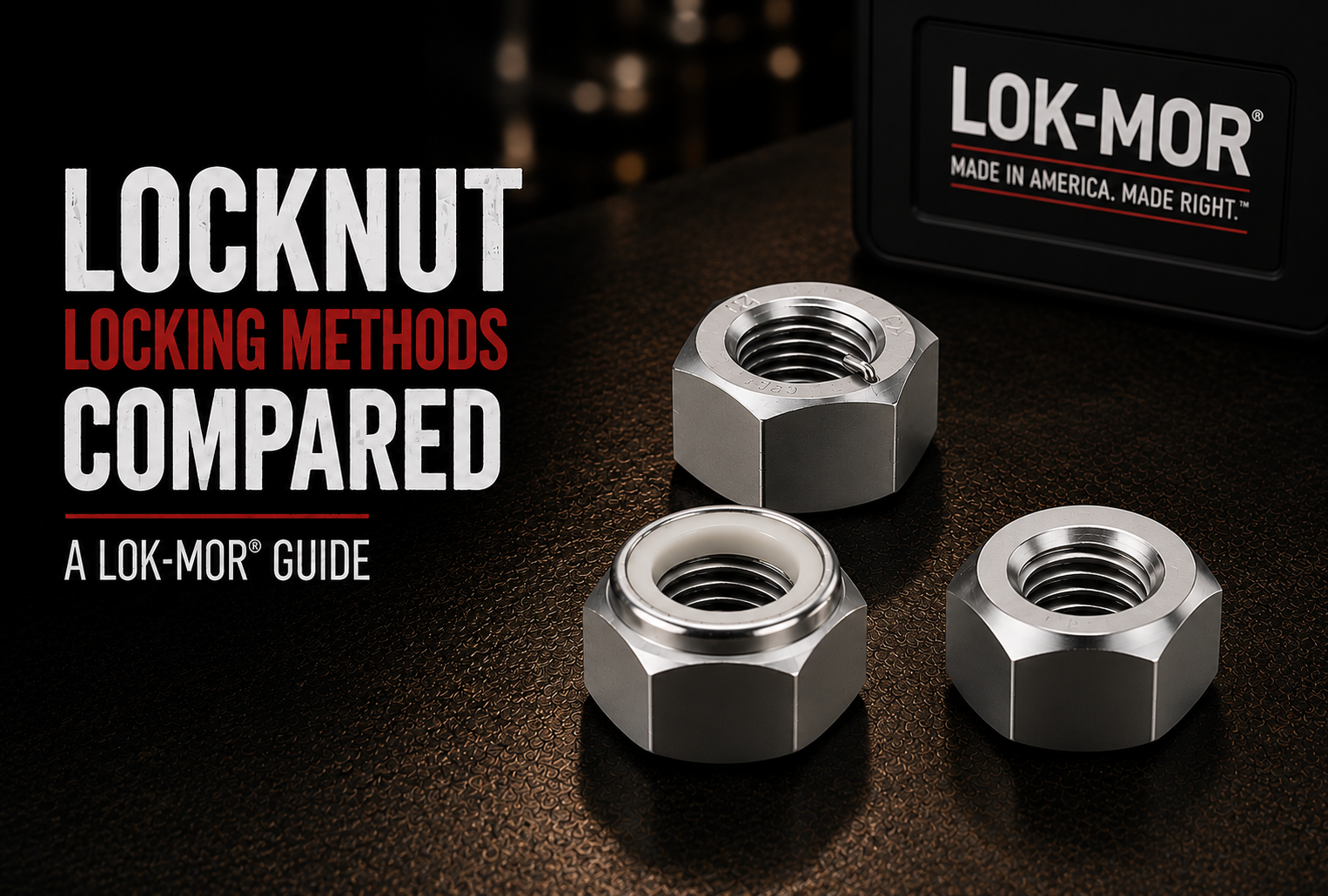
Standard hex nuts rely solely on thread-flank and bearing-surface friction to maintain clamp load, but these forces can fail under dynamic stresses such as vibration, shock loading, and thermal expansion. To ensure a secure assembly, engineers and procurement professionals typically turn to specialized locking fasteners.
This guide compares five of the most common locking methods across the two primary categories, prevailing-torque and free-spinning, to help you choose the right solution for your project.
Category I: Three Examples of Prevailing-Torque Locking Methods
A prevailing-torque locknut is designed with a deliberate interference fit that creates constant frictional resistance between the nut and the bolt threads. Unlike standard fasteners, these nuts provide rotational resistance independent of clamping or compression forces.
Because of this constant friction, these nuts cannot be threaded on by hand; they require continuous wrenching torque throughout their entire length of thread engagement. Here are three illustrative examples of different locking methods from our Made-in-America™ locknut collection:
1. Nylon-Insert Locknuts – The N-LOC™
The nylon-insert locknut, sometimes known as a nyloc, is one of the most widely used nuts due to its cost-effectiveness and reliability in general-purpose applications.
- How it Works: These nuts feature a nylon collar secured at the top. As the bolt enters the collar, its threads elastically deform and mold into the nylon, creating a tight radial friction boundary without damaging the bolt.
- Best Use: Multipurpose, or for joining softer materials like wood and plastics.
- Limitations: Standard nylon is restricted to temperatures below 250°F (121°C), as the material can soften or melt beyond this range.
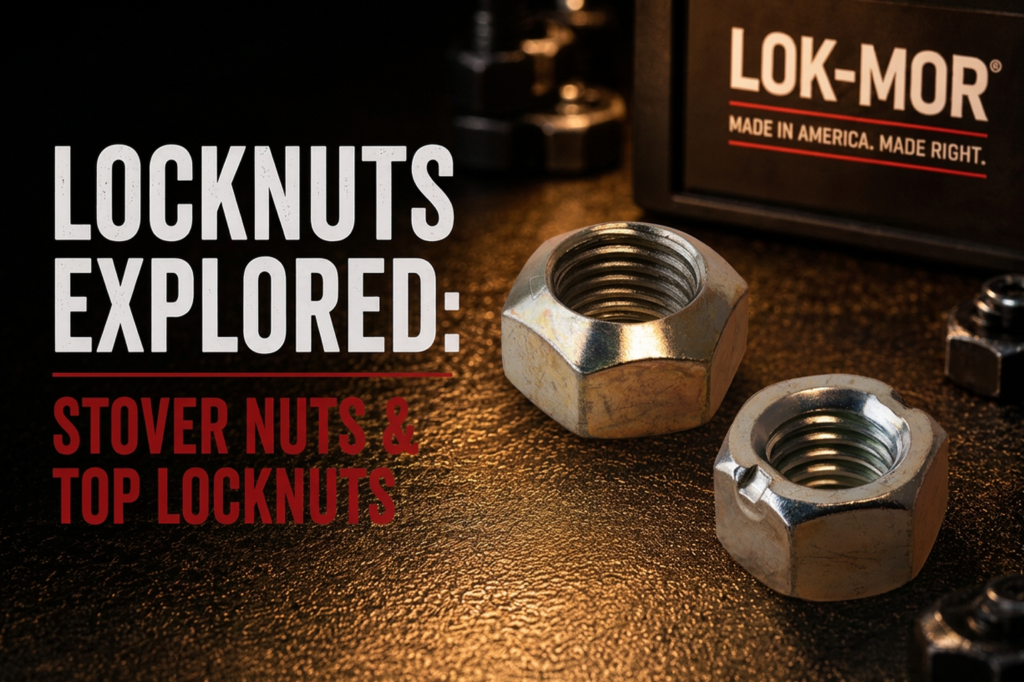
2. Top Locknuts and Stover Locknuts – The ST-LOC®
When your environment involves extreme heat or harsh chemicals that could degrade nylon, all-metal distorted-thread nuts are standard. Our ST-LOC® features positive thread deflection on both sides of the top collar, providing a highly localized gripping force that remains stable during thermal expansion.
- How it Works: These nuts generate friction through the permanent structural distortion of the internal threads. The nut is designed to distort its own threads during tightening, providing a secure lock.
- Best Use: High-temperature industrial environments and chemical exposure.
- Limitations: Cannot typically be reused.
3. Structural Pin Locknuts – The ANCO® PN-LOC®
A structural locknut is typically reserved for critical assemblies such as bridges, railcar suspensions, and utility structures. Named a 2024 Product of the Year by Fastener Technology International, the ANCO PN-LOC features an unbreakable stainless-steel ratchet pin. ‘
- How it Works: Pin locknuts like the ANCO PN-LOC rely on a ratchet pin that slides along the bolt’s threading during installation. If vibration attempts to loosen it, the pin ratchets against the bolt threads, physically stopping rotation.
- Best Use: Securing critical assemblies subjected to high levels of vibration. Commonly used for utility tower and pole applications.
- Limitations: The pin of the ANCO PN-LOC causes minor damage as it slides along the threads, which can scrape the bolt’s coating.
Category II: Two Examples of Free-Spinning Locking Methods
While prevailing-torque nuts offer constant resistance, free-spinning locknuts are designed for assembly speed and convenience. These nuts run freely down the bolt shaft until they are seated against a solid bearing surface. Their locking action is only activated after further tightening, making them ideal for applications with long thread exposures where manual threading saves time.
4. Serrated Locknuts – The SPN-LOC®
Serrated locknuts feature a bearing face with radiating circular teeth. Our SPN-LOC® offers the flexibility of having locking elements on either the bearing surface alone or on both nut faces.
- How it Works: As the nut is tightened, the angled teeth allow clockwise rotation but bite into the mating surface to physically resist backing off.
- Best Use: A serrated nut can be removed with a wrench and replaced relatively easily, making it useful for equipment that may require periodic maintenance.
- Limitations: The biting action often scratches the mating surface, which can damage paint or finishes.
5. Two-Piece Locknuts – The DRAKE™
For applications that require the advantages of an all-metal mechanical lock without the surface damage from a serrated nut, engineers often specify two-piece locknuts. The DRAKE™ is a two-piece nut available in diverse materials, including stainless steel, Monel, brass, and bronze, to match the environmental demands of the assembly.
- How it Works: These systems utilize two separate but interconnected all-metal components that work together to create a secure lock. They provide a high level of mechanical certainty by jamming or interlocking against one another during final torquing.
- Best Use: Heavy industrial joints where high clamping force and reusability are required.
- Limitations: A two-piece locknut is more complicated to install when compared to a single-piece nut.
| Locknut | Nylon-Insert | Top Lock | Structural Pin | Serrated | Two-Piece |
|---|---|---|---|---|---|
| Locknut Type | Prevailing Torque | Prevailing Torque | Structural | Free-Spinning | Free-Spinning |
| Mechanism | Nylon Deformation | Thread Distortion | Ratchet Pin | Surface Biting | Multi-Nut Jamming |
| Temperature Limit | 250°F (121°C) | High (All-Metal) | High (All-Metal) | High (All-Metal) | High (All-Metal) |
| Reusability | Limited – loses effectiveness with each use | Possible, but not typically recommended | Permanent locknut – cannot be easily removed | Limited – check sharpness of teeth before reuse | Limited |
Nylon-Insert
Top Lock
Structural Pin
Serrated
Two-Piece
The Domestic Difference: Why Lok-Mor?
Choosing the right locking method is only half the battle; the other half is choosing a manufacturer you can trust. At Lok-Mor, being Made-in-America™ is a commitment to transparency and quality.
- Faster Lead Times: By manufacturing in Mansfield, Texas, we avoid the delays associated with ocean-wide supply chains.
- A2LA-Accredited Lab: Every part we produce is backed by our state-of-the-art laboratory, ensuring our locknuts meet or exceed specifications.
- Custom Engineering: Our team works directly with yours to develop custom-built capabilities per your specific prints or samples.
Ready to secure your next project? Browse our full collection of locknuts, request a quote, email [email protected], or call us today at 800-843-7230.