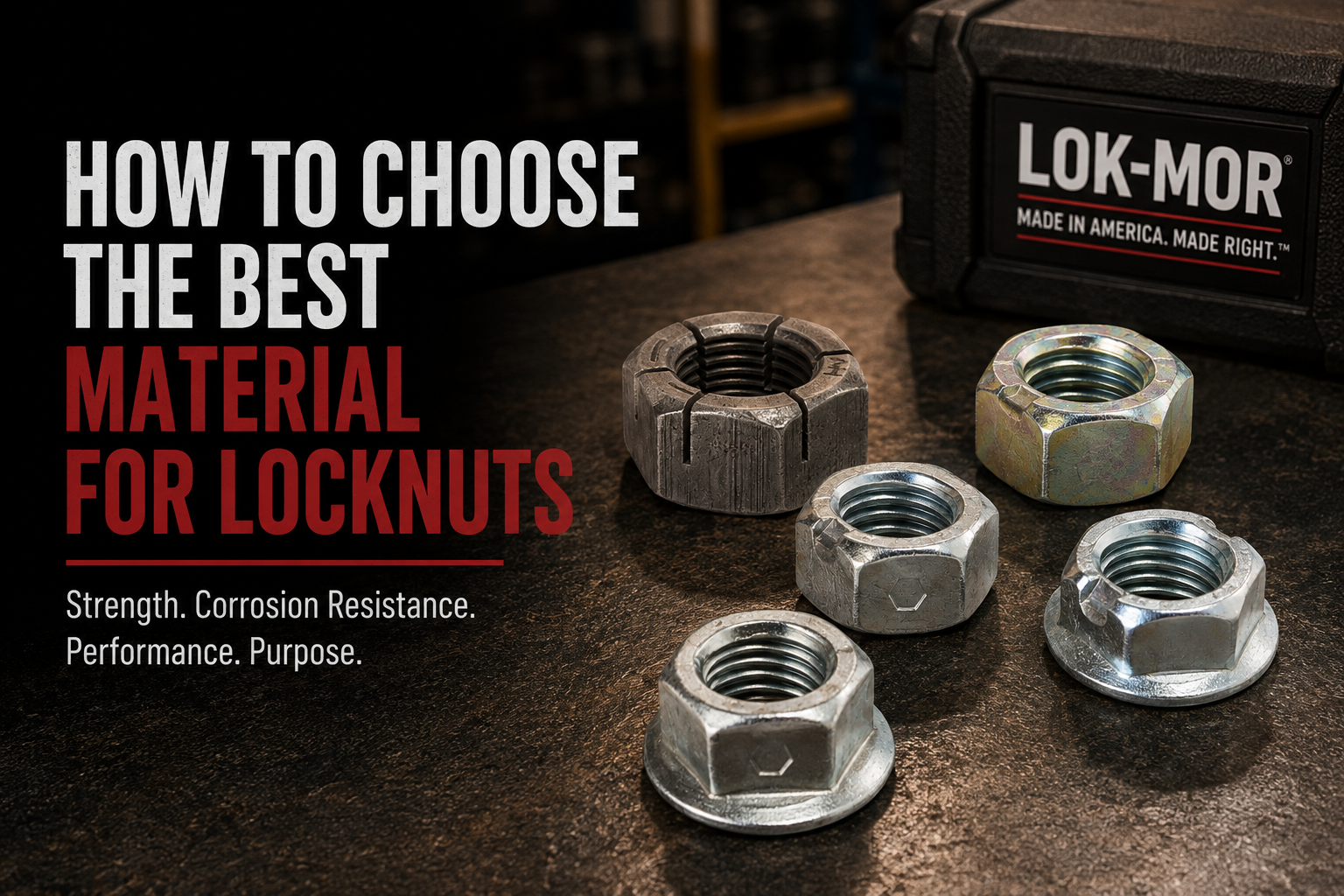
Choosing the right locknut involves more than matching the thread size and locking style. The locknut material can also affect strength, corrosion resistance, weight, service life, and overall performance.
For procurement personnel, distributors, and engineers, the challenge is that there is no single best material for locknuts. A locknut used on indoor manufacturing equipment may have very different requirements from one used on equipment exposed to saltwater, chemicals, high temperatures, or outdoor weather.
At Lok-Mor®, we manufacture locknuts for a wide range of industrial applications. This guide covers the most common locknut materials and explains what to consider before specifying or ordering a part.
What Should You Consider When Choosing a Locknut Material?
Good locknut material selection starts with the application. Before deciding on a material, consider:
- Required strength and load
- Exposure to moisture, salt, chemicals, or other corrosive conditions
- Operating temperature
- Anticipated vibratory forces
- Weight requirements
- Material and strength of the mating bolt or stud
- Required coating or finish
- Applicable specifications or certifications
- Domestic sourcing requirements
It is also important to separate material selection from locking method. The material determines properties such as strength and corrosion resistance, while the locknut design determines how the nut resists loosening.
For example, steel and stainless steel locknuts can both be manufactured with prevailing-torque locking features. Selecting stainless steel does not automatically make a nut more resistant to vibration, just as selecting a prevailing-torque locknut does not automatically make it corrosion resistant.
For more on the locking side of the selection process, read What Are Prevailing-Torque Locknuts and How Are They Used? and Choosing the Right Locknut: All-Metal versus Nylon Locknuts. If vibration is a key concern, our guide Why Do Locknuts Loosen? Understanding the Science of Joint Integrity explains the forces a locking method is designed to resist.
Steel Locknuts: Strong, Versatile, and Widely Used
Carbon and alloy steels are among the most common materials used for industrial fasteners.
Steel is popular because it offers a practical combination of strength, availability, and cost. Different grades and strength levels are available to meet the requirements of everything from general equipment to demanding structural and industrial assemblies.
The primary limitation of untreated carbon steel is corrosion. When exposed to moisture and other environmental conditions, unprotected steel can rust. That does not mean steel should only be used indoors. Various coatings and finishes can improve corrosion resistance and extend service life.
Steel may be a good choice when:
- High strength is important.
- The application is indoors or in a controlled environment.
- A coating or plating can provide sufficient corrosion protection.
- Cost and availability are important considerations.
- The engineering specification already identifies a particular steel grade.
When ordering steel locknuts, do not specify material based on size alone. The nut should have the appropriate strength for the mating bolt and the loads the assembly will experience.
Stainless Steel Locknuts: Built for Corrosion Resistance
Stainless steel is commonly selected when corrosion resistance is a priority. Unlike coated carbon steel, stainless steel derives much of its corrosion resistance from its composition. This can make stainless steel locknuts attractive for outdoor equipment and applications regularly exposed to moisture.
Common applications may include food-processing equipment, outdoor assemblies, marine equipment, and other environments where corrosion is an ongoing concern. However, simply requesting a “stainless steel locknut” may not provide enough information. Different grades of stainless steel offer different combinations of strength, corrosion resistance, and cost.
Because material choice and installation practices work together, see How to Install a Locknut: A Straightforward Guide for general guidance on installing common locknut types.
Steel vs. Stainless Steel Locknuts: Which Is Better?
One of the most common questions about locknut materials is whether to choose steel vs. stainless steel locknuts.
The answer depends on the application. Neither material is automatically “better.” A properly specified coated steel locknut may be an excellent choice for one outdoor application, while stainless steel may be necessary for another.
- Choose steel when strength, cost, and broad availability are the main priorities, and the required corrosion protection can be provided by an appropriate finish.
- Consider stainless steel when the fastener will frequently encounter moisture or corrosive conditions, and long-term corrosion resistance is a key requirement.
The better question is: What conditions does the locknut need to withstand?
Brass and Bronze Locknuts
Brass and bronze are less common than steel or stainless steel, but can be useful for specialized applications.
These copper-based alloys can provide good corrosion resistance in specific environments. Certain bronze alloys, for example, may be considered for marine applications or equipment where specific material compatibility is required.
However, brass and bronze do not have the same mechanical properties as typical fastener steels, and they should not be substituted for steel simply because corrosion resistance is needed.
Consider brass or bronze when:
- An engineering drawing specifies the material.
- The operating environment favors a copper-based alloy.
- Corrosion resistance or material compatibility is important.
- The mechanical requirements are appropriate for the selected alloy.
Aluminum Locknuts
Aluminum is an option when reducing weight is a major design objective.
An aluminum fastener weighs considerably less than a comparable steel fastener and can also offer useful corrosion resistance in many environments, making it attractive for transportation equipment and other weight-sensitive assemblies.
The tradeoff is strength – aluminum generally does not provide the same strength as high-strength steel fasteners, so it must be selected based on the actual load and joint requirements.
As with stainless steel, the specific alloy matters. “Aluminum” by itself is not always a complete material specification.
Specialty Locknut Materials
Some applications operate in conditions that conventional steel, stainless steel, brass, bronze, or aluminum may not adequately address.
Specialty alloys such as Monel, Inconel, and Hastelloy may be specified for applications involving demanding combinations of temperature, corrosion, chemicals, or other environmental factors.
These materials tend to be more specialized and expensive than standard options, so they are normally selected because a particular application requires their properties rather than simply as an upgrade from stainless steel.
Lok-Mor’s custom manufacturing capabilities include common fastener materials as well as Monel, Inconel, Hastelloy, and other specialty materials.
Material Isn’t the Whole Specification
Choosing the best material for a locknut is important, but it is only one part of the specification.
Platings, coatings, and other finishes can affect corrosion resistance, appearance, and installation characteristics. A coated carbon steel locknut, for example, may provide the required performance without changing to stainless steel. Treat the base material and finish as separate specifications when preparing an RFQ.
For more tips on giving suppliers the information they need to quote accurately, read Optimizing Your Locknut RFQ: A Practical Guide for Distributors and Procurement Professionals.
Check the Mating Fastener
A locknut works as part of a fastening system. Its material, strength, thread, finish, and locking feature must be appropriate for the mating bolt or stud.
Whenever possible, provide your supplier with the:
- Thread size and pitch
- Bolt or stud material
- Strength grade
- Finish or coating
- Operating environment
- Applicable specification
- Required locking performance
Providing these details can help prevent compatibility or performance problems before the parts reach your facility.
Need Help Choosing the Right Locknut Material?
There is no universal answer to the question, “What is the best material for locknuts?”
Steel may be ideal when strength and value are the priorities. Stainless steel may be better when corrosion resistance is critical. Aluminum, brass, bronze, and specialty alloys each have applications where their particular properties make sense.
The key is to match the material to the load, environment, mating fastener, and specification rather than choosing based on material name alone.
Lok-Mor manufactures standard locknuts and custom locknuts in a broad range of materials at our facility in Mansfield, Texas. Whether you already have a detailed print or need help identifying the appropriate material, locking style, or finish, our team can help you evaluate your requirements.
Contact Lok-Mor to discuss the right locknut for your next application.