An exposed bolt end can seem like a small detail until it snags clothing, catches debris, corrodes, or leaves a finished assembly looking unfinished. In many applications, a simple way to cover the exposed thread is to use an acorn nut.
At Lok-Mor®, we have spent more than 40 years manufacturing American-made locknuts and specialty fasteners. We also custom-manufacture special acorn nuts in locked and unlocked designs. This guide explains how acorn nuts work, where they are used, and what to consider when specifying them.
What Is an Acorn Nut?
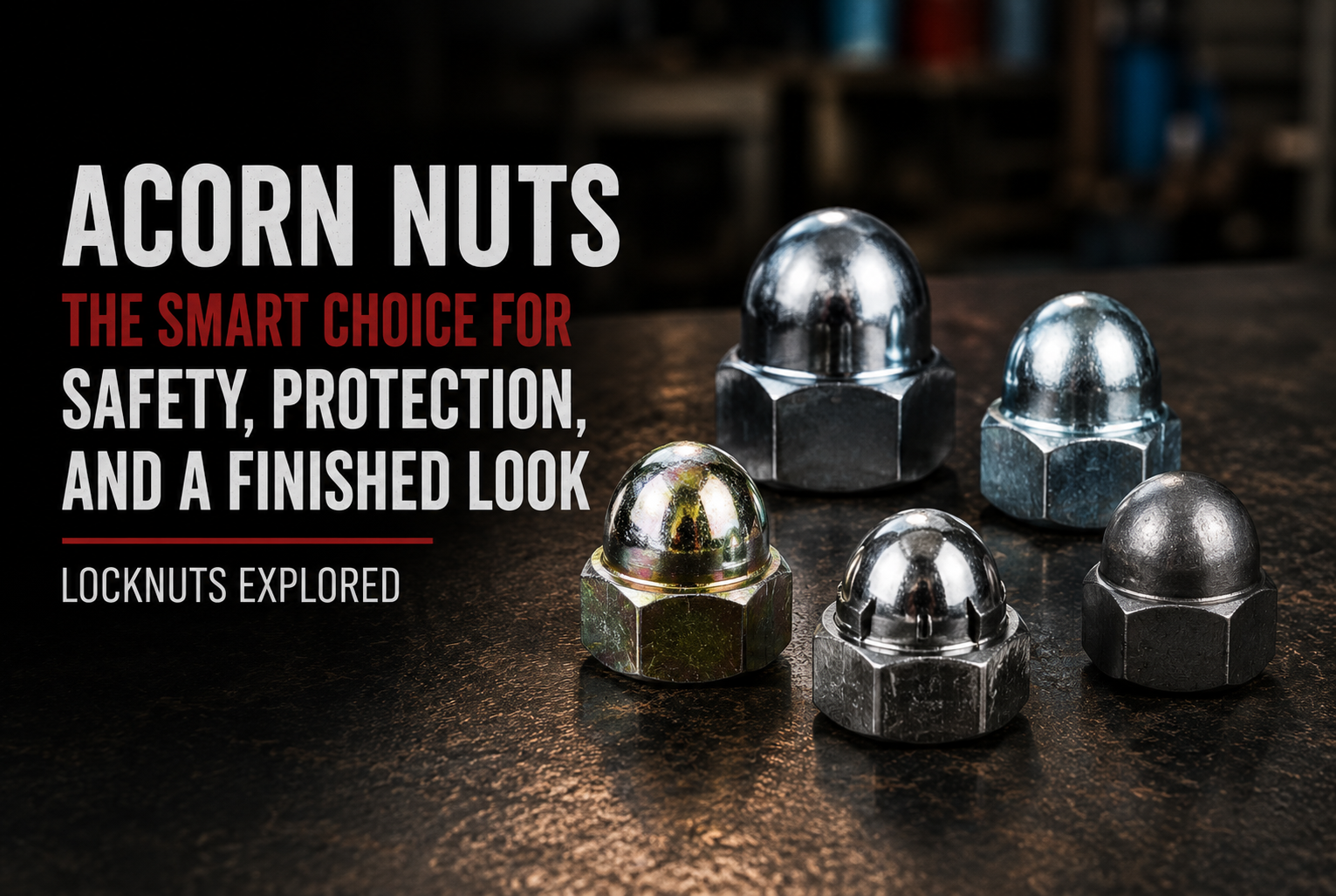
An acorn nut, also commonly called a cap nut or dome nut, is a nut with a closed, rounded end. It threads onto a bolt or stud like a conventional hex nut, but the dome covers the exposed end of the mating thread.
This closed design can reduce contact with protruding threads, shield the covered thread from debris and weather, and create a cleaner finished appearance.
Importantly, “acorn” describes the shape of the nut, not its locking action. Often, an acorn nut is simply an optional configuration for a prevailing-torque or free-spinning nut. If you are unfamiliar with the locking category, our guide to prevailing-torque locknuts explains how these designs resist loosening.
Why Use an Acorn Nut?
Acorn nuts have several practical uses:
- Safety and snag resistance: Covering an exposed bolt end creates a smoother external surface. This can be useful on equipment guards, handrails, furniture, playground equipment, and other assemblies in which people or materials may come in contact with the fastener.
- Thread protection: The closed end shields the covered threads from direct contact with dirt, impact, and moisture. In outdoor or marine environments, the cap can reduce exposure, although a standard acorn nut should not be assumed to provide a watertight or hermetic seal.
- Finished appearance: Acorn nuts are common on visible assemblies because the dome hides the end of the bolt or stud. Material and finish options can be selected to match surrounding components or meet corrosion-resistance requirements.
- Cleanability: A capped fastener leaves less exposed thread on the outside of an assembly, which can reduce areas where debris collects. For food, pharmaceutical, or other sanitary applications, the fastener design, material, surface finish, and applicable hygienic requirements must all be considered. One should not assume, however, that a standard acorn nut is a sanitary fastener.
Common Acorn Nut Applications
Because acorn nuts combine a closed end with familiar wrenching surfaces, they can be used across industrial and consumer applications. Examples include machinery and equipment, transportation components, outdoor structures, architectural metalwork, handrails, furniture, guards, panels, and other assemblies where exposed threads are undesirable.
For high-vibration or dynamic applications, an acorn locknut may be more appropriate than a free-spinning cap nut. The choice depends on loading, vibration, environment, installation, and the governing specification. For more background on the forces involved, see Why Do Locknuts Loosen? Understanding the Science of Joint Integrity.
Examples of Locknuts with Acorn Configurations
At Lok-Mor®, we offer several of our prevailing-torque locknuts in acorn configurations. Two illustrative examples are the HEX-LOC® and PEL-LOC™:
- The HEX-LOC®: an all-metal, prevailing-torque locknut. Its threads are deflected at the center of the nut, creating frictional interference with the mating bolt threads. In an acorn configuration, the HEX-LOC combines a covered bolt end with an all-metal prevailing-torque lock.
- The PEL-LOC™: a two-way prevailing-torque locknut that uses a nylon pellet positioned through the wall at the center of the nut. As the bolt engages the pellet, the nylon creates frictional thread interference. The acorn configuration pairs a domed profile with the nylon locking element. Service temperature and chemical exposure should be considered when specifying any nylon locking feature.
These two nuts offer similar performance, but the differences between an all-metal and nylon-insert locknut are important to consider. For a more detailed comparison, read our guide to choosing between all-metal and nylon locknuts.
Acorn Nuts vs. Cap Nuts: Is There a Difference?
“Acorn nut,” “cap nut,” and “dome nut” are often used interchangeably. For purchasing and engineering, the required standard, dimensions, thread, and dome height are more useful than the name alone.
Two common metric standards illustrate the difference in cap-nut geometry:
- DIN 917: Covers low-type hexagon cap nuts. These have a lower overall profile and less internal space above the threaded portion.
- DIN 1587: Covers high-type hexagon cap nuts. These have a taller dome and more internal clearance.
Internal clearance is more than a cosmetic detail. The bolt or stud needs enough room for the nut to seat properly. If it bottoms out against the dome first, the joint may not achieve the intended clamp. Check bolt protrusion and internal depth during design and procurement. For broader installation basics, see our straightforward guide to installing a locknut.
What to Specify When Buying Acorn Nuts
For procurement teams and distributors, “acorn nut” alone usually is not enough for an accurate quote. Include the details that affect fit, performance, and lead time.
- Thread size and pitch: Confirm inch or metric thread, pitch or threads per inch, thread class when applicable, and whether a standard or left-hand thread is required.
- Internal depth and bolt protrusion: Verify that the nut has enough internal clearance for the exposed bolt or stud without bottoming out before the joint is seated.
- Locking requirement: Specify whether the nut can be free-spinning or must include a prevailing-torque or other locking feature.
- Material and mechanical requirements: Select material and strength requirements that are compatible with the mating fastener, service loads, temperature, and environment.
- Finish or coating: Identify corrosion-resistance, appearance, plating, coating, or secondary-processing requirements.
- Geometry or governing standard: Provide the applicable drawing or standard, overall height, wrench size, dome profile, and any nonstandard dimensional requirements.
- Documentation and domestic requirements: If the project requires material test reports, plating certifications, certificates of compliance, lot traceability, or specific domestic-content requirements, include those needs in the RFQ.
Details like these are critical for getting fast and accurate quotes. Our practical guide to optimizing a locknut RFQ explains what information helps distributors and procurement teams get more complete quotes with less back-and-forth.
Custom Acorn Nuts from Lok-Mor
Lok-Mor custom manufactures special acorn nuts in locked or unlocked configurations, including standard, nonstandard, metric, and left-hand threads. Depending on the part, we can produce components from bar stock or by cold- and hot-forming in a broad selection of materials.
All Lok-Mor manufacturing and locking processes are conducted at our Mansfield, Texas, headquarters. Our quality program is supported by an A2LA-accredited laboratory and is established to meet requirements including ISO 9001:2015, Mil-I-45208, ISO/IEC 17025, ANSI/ASME, and ASTM specifications as applicable. Material test reports, plating certifications, certificates of compliance, and lot traceability are available to support customer requirements.
For more context, read our Guide to Locknut Standards and Certifications and our overview of why ASTM standards matter for your project.
Choosing the Right Acorn Locknut
Acorn locknuts are a helpful option for covering exposed bolt threads, especially those subject to vibration. It is important to remember that an acorn locknut refers to the dome shape at the top of the nut, not the locking method. For best results, the locknut should still match the joint’s thread, available internal clearance, material, finish, mechanical requirements, and locking needs.
Our locknut experts are available to help you find the right option for your application. Browse our complete line of locknuts or contact a Lok-Mor expert at 800-843-7230 or [email protected].