Since 1982, we at Lok-Mor® have built a hard-earned reputation as a leading manufacturer of American-made locknuts. In this blog, our locknut experts explain a specialized class of hardware designed for the most extreme environments: locknuts with pins and keys.
The Problem with Vibration
Vibration is a constant threat to assembled joints, especially in industries like oil and gas, shipbuilding, and manufacturing. Continuous motion causes locknuts to gradually slide against bolt threads, leading to a loss of tension and, eventually, joint failure.
To combat this, hardware manufacturers like Lok-Mor® have developed specialized locknuts with pins and keys. Here’s how they work.
What are Pin Locknuts?
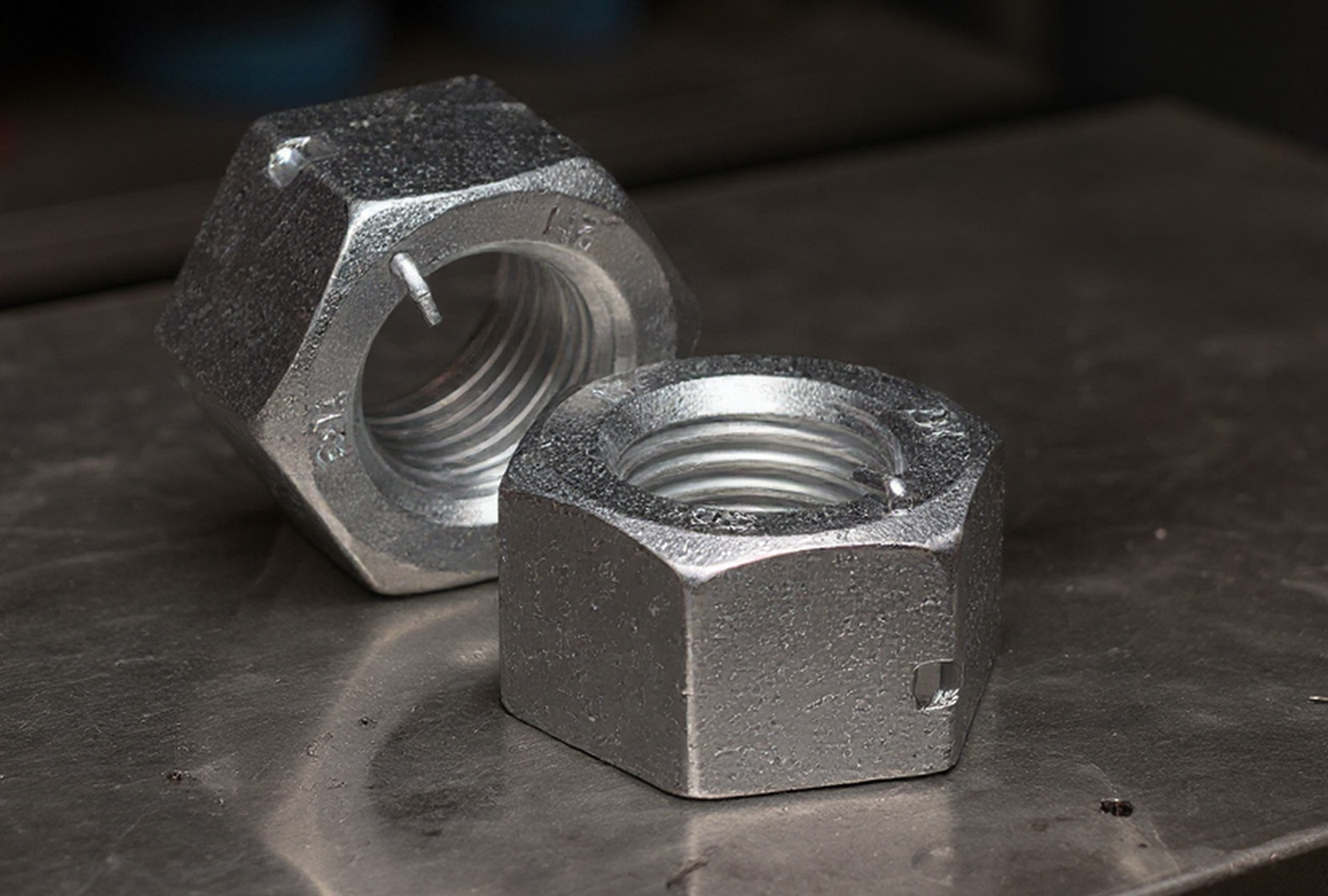
A pin locknut utilizes a metal ratchet pin to prevent the nut from backing off. While traditional prevailing-torque nuts stay in place by squeezing the bolt, a pin locknut creates a positive-stop interaction.
The pin effectively acts as a wedge: as you tighten the nut, the pin moves over the threads; if the nut tries to loosen due to vibration, the pin engages the threads to block rotation.
Common Pin Locknut Applications
- Infrastructure: Bridges and towers where safety is paramount.
- Heavy Machinery: Cranes and excavators subject to heavy shock loads.
- Transportation: Railcars and trailers that face constant dynamic movement.
Pin Locknut Example – The ANCO® PN-LOC®
Our flagship product, the ANCO® PN-LOC®, is the best example of a pin locknut – it features an unbreakable stainless steel ratchet pin and a unique controlled-lock indentation.
This combination ensures the nut provides a consistently reliable locking force every time. Once the pin is engaged, the ANCO PN-LOC isn’t coming off.
With over 95 million installed, the ANCO PN-LOC is the trusted industrial solution for vibration, which is why Fastener Technology International named it a top product of 2024.
What are Key Locknuts?
Key locknuts prioritize security and permanence, designed to stay in place indefinitely.
Unlike many other locknuts that are difficult to turn the moment they touch the bolt, key locknuts are typically free-spinning – they spin easily onto the bolt by hand until they reach the base surface. Once they are seated and tightened, a specialized mechanical key is activated to lock the assembly into place.
Common Key Locknut Applications
- Public Infrastructure: Deterring tampering with essential public installations or utility towers.
- Safety Equipment: Ensuring that critical mechanisms remain functional and cannot be accidentally adjusted.
- Security Systems: Preventing the unauthorized disassembly of industrial components.
Key Locknut Example – The The KEY-LOC™
For projects where a joint must be permanent, Lok-Mor provides the KEY-LOC™. This is our premier non-reversing solution for environments where unauthorized removal is a risk.
The installation of the KEY-LOC is fast and efficient because of its free-spinning design. Once the nut is at the fastening surface, installation is completed by striking the key with a hammer to drive it into the threads. Once the locking key is engaged, the nut becomes non-removable.
This mechanical lock prevents the nut from loosening under even the most extreme vibration or torque, providing a secure and tamper-proof connection.
Made in America. Made Right.™
Whether you need the structural integrity of the ANCO® PN-LOC® or the permanent security of the KEY-LOC™, Lok-Mor® ensures that every part is manufactured to the highest standards.
We manufacture, lock, and test all our fasteners at our Texas headquarters, providing our customers with full traceability and some of the fastest lead times in the industry.
Our quality program meets rigorous international specifications, including ISO 9001 and ASTM, and is supported by a state-of-the-art A2LA-accredited lab. This commitment to technical excellence gives our customers peace of mind that their most critical assemblies will stay together.
Do you have questions about the right mechanical lock for your assembly?
- Call a Lok-Mor expert: 800-843-7230
- Email fora quote: [email protected]
- Fill out a form to Request a Quote
- See the full Made-in-America™ lineup of locknuts