When a bolted joint absolutely cannot loosen, even under constant vibration or dynamic loads, engineers often turn to castle nuts. Unlike prevailing torque or nylon insert locknuts, castle nuts use a cotter pin to create a positive mechanical lock, making them a trusted choice for critical applications where failure isn’t an option.
At Lok-Mor, we’ve spent more than 40 years manufacturing American-made locknuts for demanding industries, and one of the most common questions we hear is how castle nuts compare to other locking fasteners. Often confused with the closely related slotted nut, castle nuts offer unique advantages that make them the preferred solution in many applications.
This guide explains how castle nuts work, where they’re used, how they differ from slotted nuts, and what you need to know for proper installation.
What is a Castle Nut
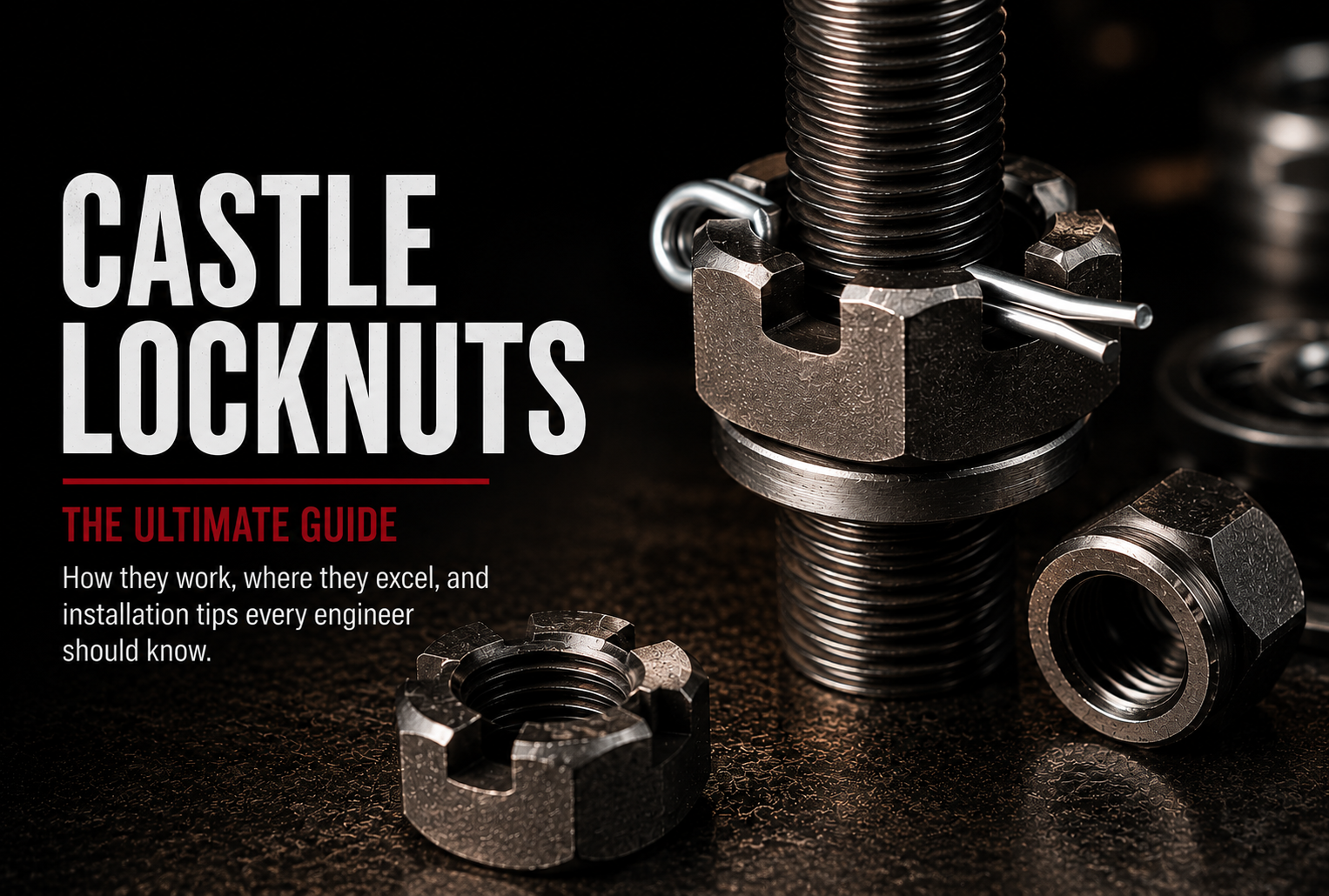
A castle nut (technically known as a castellated nut) is a hexagonal nut with radial slots or notches cut into one end. The name is derived from its resemblance to the parapets of a medieval castle.
Castle locknuts consist of two sections:
- The Hexagonal Base: The lower portion of the nut is a standard hex body that serves as the wrenching area.
- The Cylindrical Crown: The upper portion features a cylindrical turret, or crown, where the slots are located.
This rounded crown distinguishes it from a standard slotted nut, which has slots cut directly into the flat top of the hexagonal body. Because the castle nut is formed with this raised turret, it is typically taller than a slotted nut of the same thread size.
How a Castle Nut Works: The Pin & Nut Combination
Unlike nylon-insert locknuts or all-metal prevailing-torque nuts that rely on friction or thread deformation to stay tight, the castle nut is a positive mechanical locking device. It does not work alone – it is part of a three-component system:
- The Nut: Features the slots.
- The Bolt or Stud: Must have one or two radial holes pre-drilled through its threaded end.
- The Pin: Usually a split cotter pin, safety wire, or an R-clip.
Common Pin Locknut Applications
- Infrastructure: Bridges and towers where safety is paramount.
- Heavy Machinery: Cranes and excavators subject to heavy shock loads.
- Transportation: Railcars and trailers that face constant dynamic movement.
The Mechanics of the Lock
During installation, the nut is torqued down to the required specification. Once seated, one of the nut’s slots is aligned with the hole in the bolt. The pin is then passed through both the nut slots and the bolt hole, with its legs bent to prevent it from being removed.
The pin does not carry the clamping load: the bolt’s tension does. Instead, the pin acts as a physical barrier. If vibration or shock tries to rotate the nut, the wall of the slot contacts the steel pin and stops. The nut physically cannot back off as long as the pin is in place.
Castle Nuts vs. Slotted Nuts
The terms “castle nut” and “slotted nut” are often used interchangeably, but the distinction is vital for high-precision engineering.
The rounded turret of the castle nut allows the cotter pin or safety wire to be confined more tightly to the margins of the nut body. By wrapping the pin legs closely around the cylindrical turret, installers can minimize the envelope size of the assembly. This prevents the sharp legs of a split pin from snagging on clothing, equipment, or nearby components.
Furthermore, standard castle nuts offer a higher profile and deeper thread engagement, making them better suited for high-stress structural joints in mechanical engineering.
A Note on Pins
Always remember that without the pin, a castle nut is just an oddly shaped hex nut that holds no better than an unsecured fastener. Additionally, it is vital to never reuse a cotter pin. Bending and unbending the legs work-hardens the steel, making it brittle and more susceptible to shearing under vibration. The pennies it costs to replace a pin are worth it to avoid the risk of catastrophic joint failure.
Important Installation Information – A Common and Dangerous Mistake
There is one rule of castle nut installation that is more important than all others: Never loosen the nut to align it with the cotter pin hole.
In automotive and industrial work, technicians often encounter situations where, at the specified torque, the nut slot does not align perfectly with the bolt hole. Many make the mistake of slightly backing off the nut to reach the previous slot.
On safety-critical joints (such as ball joints or tapered drive axles), loosening the nut can release the “taper seat”. This can cause the taper to slip during service, dropping the clamping force and potentially leading to a catastrophic fatigue failure of the stud.
The Correct Procedure
- Torque the nut to the manufacturer’s minimum specification.
- Inspect the alignment. If it doesn’t match, don’t loosen the nut. Instead, continue tightening it until it reaches the next slot.
- If you cannot reach the next slot within the maximum allowable torque window, something is wrong – such as a stretched bolt or the wrong washer stack. In these cases, replace the suspect parts or adjust with selective shimming rather than forcing or loosening the nut.
Ideal Use for Castle Nuts
Castle nuts are commonly specified when the consequences of a backed-off nut include personal injury or equipment loss. Common applications include:
- Automotive Steering and Suspension: This is the largest market for castle nuts, securing ball joints, tie rod ends, and pitman arms, where reversing loads and constant vibration occur.
- Aerospace: Used in aircraft structures and engines where high temperatures might melt a nylon insert, the purely mechanical lock of a castle nut and pin ensures joint integrity.
- Wheel Assemblies: Crucial for drive axles, CV joints, and trailer hubs, where they maintain the precise preload required for wheel bearings.
- Marine Propulsion: Castle nuts are standard for securing propeller shafts, where vibration is intense and serviceability is essential.
The Lok-Mor Advantage: Made in America. Made Right.™
As a premier domestic manufacturer, we at Lok-Mor don’t just sell locknuts. Our Mansfield facility can produce castle nuts that meet the world’s most demanding standards.
- Custom Capabilities: We regularly manufacture special castle nuts in standard, non-standard, and left-hand threads. Whether you need them per-print or per-sample, we can execute with precision in any quantity.
- Broad Material Selection: We offer castle nuts in steel grades 2, 5, and 8, as well as stainless steel, brass, bronze, Monel, and other alloys for extreme environments.
- Verified Quality: Every part we produce is backed by our A2LA-accredited lab. Our quality program is established to meet ISO 9001, Mil-I-45208, and ASTM specifications, ensuring peace of mind.
By choosing domestically manufactured castle nuts, you invest in your brand’s safety and reliability. When the integrity of your assembly depends on a positive mechanical lock, trust the hardware that is Made in America. Made Right.™.
Do you have questions about the right mechanical lock for your assembly?
Ready to secure your next critical joint?
- Call 800-843-7230 or email us at [email protected]
- Submit a Contact Form or Get a Quote
- Browse our complete Made-in-America™ collection of locknuts