At Lok-Mor, we’ve spent over 40 years manufacturing the highest-quality fasteners from our facility in Mansfield, Texas. While we are often recognized for our award-winning structural and prevailing-torque locknuts, a simpler, low-profile component remains a staple in industrial assemblies: the jam nut.
Often misunderstood or installed incorrectly, the jam nut is a vital tool for engineers and procurement specialists dealing with space constraints and vibration. Here’s everything you need to know about this versatile fastener.
What is a Jam Nut?
A jam nut is a low-profile type of nut, typically about half as tall as a standard hex nut. While it looks like a standard nut thinned down, it has a specific function. It is designed to be “jammed” against another nut to lock both into place.
Their slim design makes jam nuts the space-savers of the fastener world. They are used in environments where a standard-height nut simply will not fit or where fine adjustments are required – such as in steering linkages or hydraulic cylinders.
How Do Jam Nuts Work?
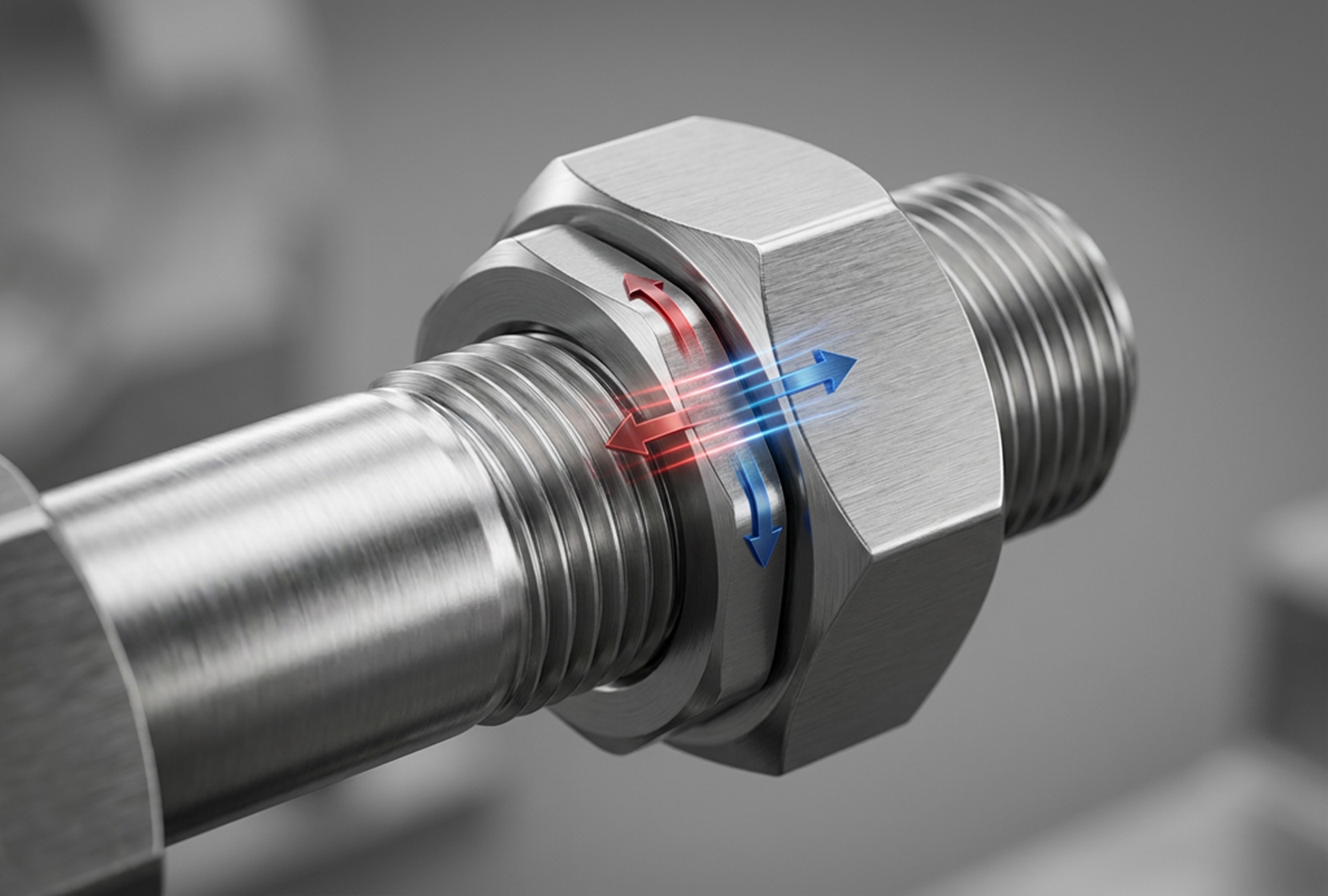
The effectiveness of a jam nut system doesn’t come from the nut itself, but from the forces created during installation. When two nuts are tightened against one another on a bolt, they push in opposite directions. This action creates constant tensile stress in the short section of the bolt threads between them.
This wedging action holds the nut threads in constant contact with the bolt threads, preventing the assembly from rotating or loosening due to vibration. When installed correctly, the outer nut carries the primary tension of the joint, while the jam nut maintains a stable position.
Common Applications and Advantages
Jam nuts are found in nearly every major industry due to several key advantages:
- Space and Weight Efficiency: In precision engineering like robotics or aerospace, every millimeter and gram matters. Jam nuts provide secure locking without the bulk of a standard assembly.
- Adjustability: They are ideal for applications where you need to secure an item on a fastener without applying a massive clamping force to the object itself, such as in optical equipment or medical devices.
- Cost-Effective: By using less material than full-height nuts, jam nuts are a cost-effective choice for long-term projects.
- Threaded Rods: Jam nuts are often used in pairs to create a temporary “head” on a threaded rod, allowing a wrench to turn the rod into a tapped hole.
How to Install a Jam Locknut – Which Nut Goes First?
Established engineering principles dictate that the thinner jam nut should go on the bolt first, followed by the thicker, full-height locknut.
- The Inner Nut: Install the thin jam nut and tighten it to approximately 25% to 50% of the final required torque.
- The Outer Nut: Thread the thicker nut on top.
- The Jam: While holding the thin inner nut stationary with a wrench, tighten the thicker outer nut to its full torque value.
This order ensures that the thicker nut carries most of the load, while the thin nut provides friction to prevent self-loosening.
The Lok-Mor Advantage: Precision and Selection
At Lok-Mor, we don’t just supply commodity hardware; we manufacture precision-engineered locknuts and related hardware. We offer jam configurations for many of our most popular Made-in-America™ styles, including:
- The SPN-LOC® – This reusable, free-spinning locknut is serrated on the bearing surface. When tightened, these serrations bite into the mating surface for enhanced locking strength. For the jam variant, these serrations bite into the bottom nut to provide an extra-powerful assembly.
- The N-LOC™ – This is our signature nylon-insert locknut (sometimes called a nyloc), featuring a nylon insert that deforms around the threads during tightening to create a powerful seal. The jam variant makes this versatile nut capable of fitting in tight spaces without compromising on locking power.
- The C-LOC™ – This permanent locknut offers a powerful solution to vibration. The nut has an oval-shaped collar at the top that deforms during installation to provide a reliable lock. The jam variant is lighter weight but can still withstand extreme vibration.
Every part that leaves our Mansfield facility is supported by our in-house A2LA-accredited lab, ensuring your fasteners meet the exact specifications for your application.
Made in America. Made Right.™
Whether you need a specialized jam nut for a high-vibration engine assembly or custom-manufactured hardware for a structural project, Lok-Mor has the expertise to ensure your joints stay secure.
Need technical guidance on the right nut for your application?
- Contact a Lok-Mor expert: 800-843-7230
- Email for technical specs: [email protected]
- Request a Quote
- See the full Made-in-America™ lineup of locknuts